
- Navigator
- Toolbox
- Status Bar
- Working with windows
- Hot keys
Navigator
Navigator window allows you to work with files and folders inside the trading platform's /MQL4 or /MQL5 directories. They store trading robots, indicators and scripts, as well as source code files and other data for programming on MetaQuotes Language. Press Ctrl+D or execute  Navigator command of the View window or in the Standard toolbar to show/hide the window.
The window resembles a file manager displaying folders and files as a tree list:
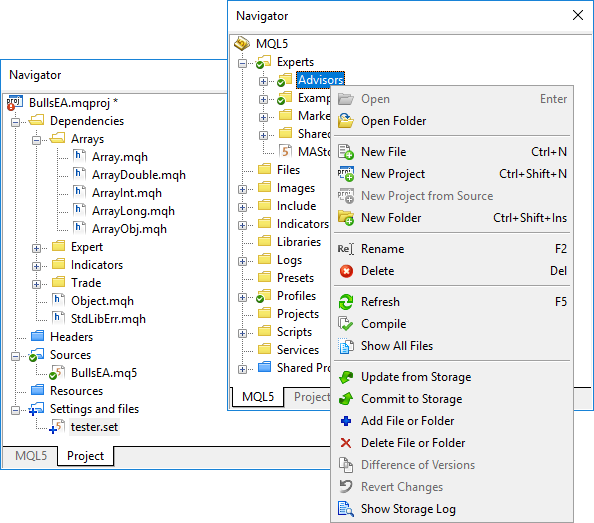
A similar structure is displayed in the Navigator window of the trading platform. For example, if you create your indicator in the MQL5\Indicators\MyIndicator\ directory, you can launch it in the trading platform from the same directory.
To view the folder contents or open a source file for editing, double-click on an appropriate element in the Navigator. To re-locate a folder/file, select it and drag to a necessary directory while holding the left mouse button (Drag'n'Drop).
External changes to directories and files (via Windows Explorer) are also displayed in the Navigator window.
Project #
A separate Navigator tab is designed for managing projects. All used files are arranged into various categories:
- Dependencies – include files. These are files with the source code, which are used in the project. For example, dependencies may include standard library files.
- Headers – header files. Such files contain custom identifiers, macros, structures and other constructions used in the project.
- Sources – source code files of the project.
- Resources – resource files, such as images, sounds, etc.
- Settings and files – sets of input parameters (*.set) and other files.
Read more about how to work with projects in the separate section.
Context menu #
The available context menu commands (and how a chosen command works) depends on the file or folder involved.
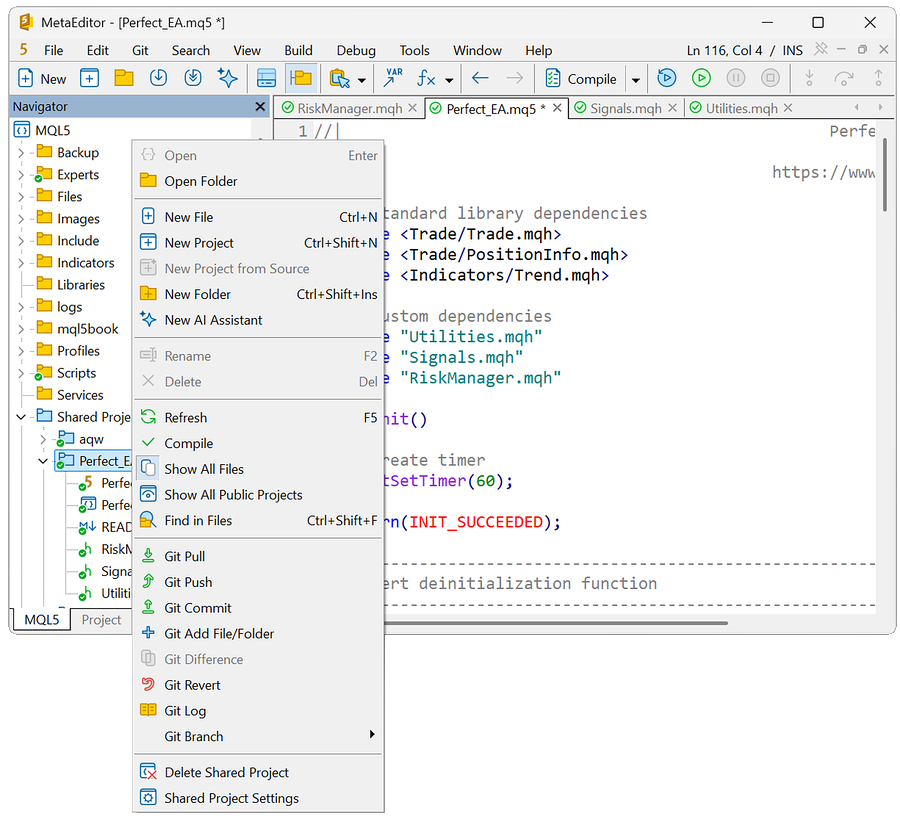
The full list includes:
- Open – open a selected file for editing. The same action can be done by double clicking on the file or by pressing Enter.
- Open Folder – open a selected folder or a folder containing a selected file.
- New File – create a new MQL4/MQL5 program using MQL4/MQL5 Wizard.
- New Project – create a new project.
- New Project from Source – create a new project from the selected source file.
- New Folder – create a new folder in the current directory. The same action can be performed by pressing Insert.
- New AI assistant – open the AI Assistant.
- Rename – rename a selected file or folder. The same action can be performed by pressing F2.
- Delete – delete a selected file or folder. The same action can be performed by pressing Delete.
- Refresh – refresh the Navigator window. If files or folders are copied to one of MQL4 or MQL5 sub-folders, these changes are automatically displayed in the Navigator window. However, you can manually re-read the file structure by executing this command or by pressing F5.
- Compile – compile a selected file. Executing this command for a folder results in compilation of all files contained in it.
- Show All Files – show/hide all files. If the option is disabled, the source code (*.MQ4, *.MQ5, *.MQH, *.CPP and *.H) and text files (*.TXT and *.CSV) are displayed in the Navigator, while executable ones are hidden.
- Show All Public Projects – show all public projects available to you.
- Git Pull – fetch all changes available on remote, which updates the local files.
- Git Push – send commits containing local changes to remote. MetaEditor runs Git Push automatically after each Git Commit, so you may never have to use this command.
- Git Commit – commit the current state of your project to the version history, with MetaEditor pushing the changes to remote automatically.
- Git Add File/Folder – add a local folder or a file so that it starts being tracked by Git.
- Git Difference – review changed files in staging before committing. The comparison panel shows added, deleted, or modified lines.
- Git Revert – delete staged changes that are yet to be committed.
- Git Log – show all commits with their date, author, and commit message. This lets you track who changed what and when.
- Git Branch – access a menu to create a new branch and switch between branches.
- Delete Shared Project – delete the selected shared project.
- Shared Project Settings – open the shared project's settings, where you can control its visibility.